Chemical Earthing vs Conventional Earthing: Which Earthing System Is Better?
If you're planning a new electrical installation or replacing an aging earthing setup, one thought is likely to come up sooner or later: chemical earthing vs conventional earthing method.
Both are built to perform the same job: safely carry fault current into the ground. The difference lies in how consistently they do it over the years.
Factors like soil conditions, corrosion, maintenance requirements, and long-term performance can make one option far more practical than the other.
In this article, we'll compare both systems across the parameters that actually influence safety, reliability, and overall value.
Why the Choice of Earthing System Matters More Than Ever
Not long ago, a conventional earthing system was the default choice for most electrical installations. It worked well in many cases, particularly where soil conditions remained favourable and regular maintenance wasn't a concern. Today's installations are different. Higher electrical loads, automation, electronic controls, and expensive equipment leave far less room for inconsistent grounding performance.
Because of this shift, the discussion is no longer limited to getting an earthing system installed. The focus has moved towards keeping earth resistance stable throughout the system's service life. That expectation is one of the main reasons chemical earthing is now being considered alongside conventional methods for many commercial and industrial projects.
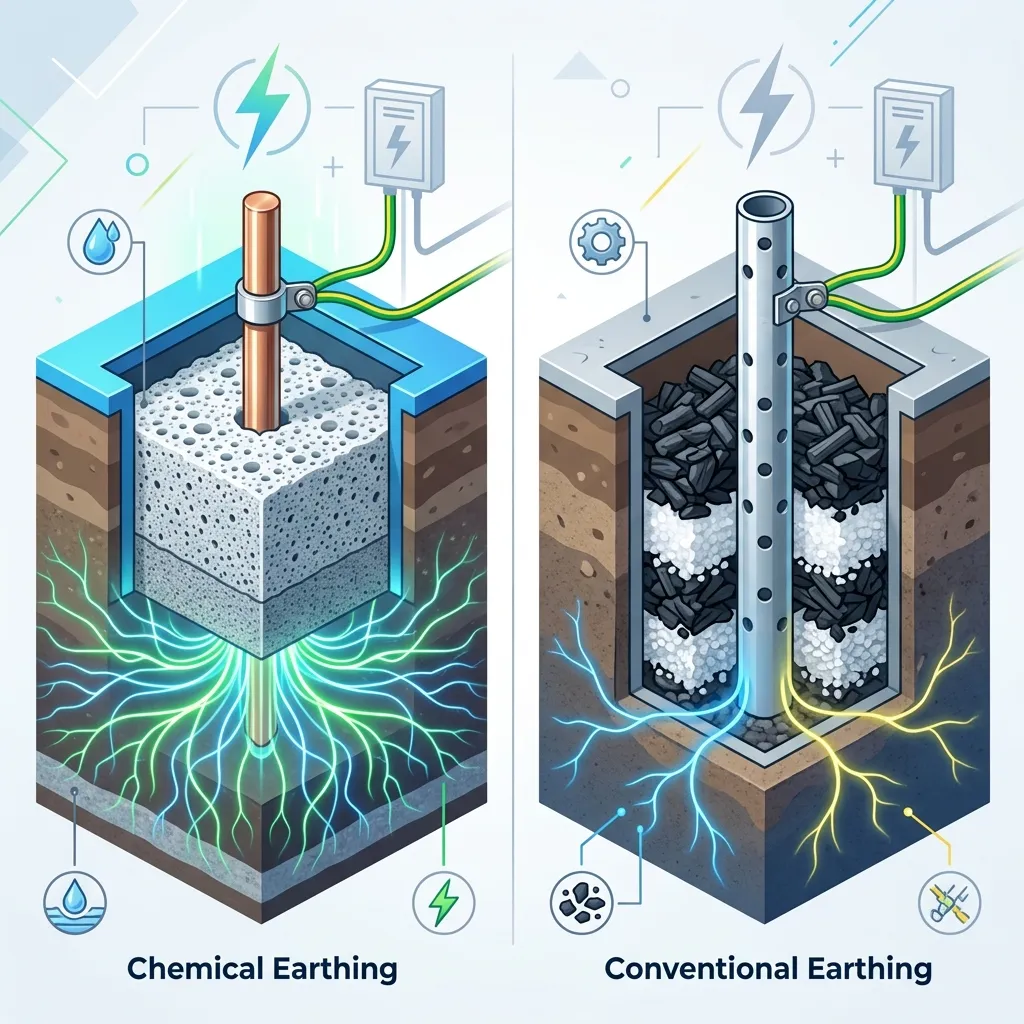
Chemical Earthing Vs Conventional Earthing
Choosing between chemical and conventional earthing two systems becomes easier when you compare them across the factors that influence day-to-day performance and long-term reliability. Here's a quick overview before we look at each aspect in more detail.
| Parameter | Chemical Earthing | Conventional Earthing |
|---|---|---|
| Earth Resistance | Remains comparatively stable under varying soil conditions | May fluctuate with seasonal changes and soil moisture |
| Earthing Electrode | Typically uses copper bonded or GI electrodes with conductive backfill | Generally uses GI pipe, GI plate, or copper plate electrodes |
| Maintenance | Requires minimal periodic attention | Needs regular inspection and watering in many locations |
| Corrosion Resistance | Better protection against corrosion when installed correctly | Performance can decline as corrosion develops over time |
| Installation Cost | Higher initial investment | Lower initial investment |
| Long-Term Cost | Often lower due to reduced maintenance | Can increase because of maintenance and replacement requirements |
| Suitable Applications | Industrial facilities, commercial buildings, data centres, hospitals, renewable energy projects | Residential properties, small commercial installations, temporary applications, and budget-focused projects |
Why Has Chemical Earthing Gained Wider Acceptance?
A few years ago, conventional earthing was the obvious choice for most projects. It was familiar, economical, and suitable for many installations. That hasn't changed entirely, but project requirements certainly have.
Electrical systems today support sensitive equipment, continuous operations, and higher connected loads. At the same time, soil conditions rarely remain consistent throughout the year. When earth resistance starts varying with seasonal changes, maintaining the required performance often needs additional attention.
This is one reason many consultants and project owners now evaluate a chemical earthing system during the design stage itself. The preference isn't driven by a new trend. It's driven by the expectation that the installation should continue performing reliably without frequent intervention.
Performance Doesn't Stay the Same After Installation
An earthing system isn't judged only by the resistance value recorded during commissioning. What matters is whether that value remains within an acceptable range after years of service. Rainfall, prolonged dry weather, soil movement, and corrosion gradually influence how effectively current is dispersed into the ground.
A resistance reading taken during installation tells only part of the story. As seasons change, the soil around the earthing electrode may lose moisture, become compact, or turn more corrosive. Under such conditions, a conventional earthing system can experience noticeable changes in earth resistance. A properly installed chemical earthing system is better equipped to maintain stable performance, reducing the need for frequent corrective maintenance.
Maintenance Often Decides the Long-Term Value
The installation cost is paid once, but maintenance continues throughout the life of the earthing system. That's why many project owners look beyond the initial investment before making a decision.
A conventional earthing system may require periodic inspection, watering, or corrective work if earth resistance increases over time. A well-designed chemical earthing system generally demands less routine attention because the conductive backfill helps maintain stable contact around the earthing electrode. While there is no installation that involves completely maintenance free earthing, reducing frequent intervention can lower operating costs and minimise unexpected downtime over the years.
A Lower Initial Cost Doesn't Always Mean Better Value
For many projects, conventional GI grounding appears to be the more economical option because the installation cost is generally lower. That can be a sensible choice where soil conditions are favourable, electrical loads are modest, and periodic maintenance is already part of the site's routine.
The equation changes when consistent performance and reliable electrical safety solutions become a priority. Industrial plants, commercial facilities, hospitals, and data centers require a low resistance earthing system that reduces the likelihood of rising resistance and repeated maintenance work. In such cases, the overall value of an earthing system is measured over years of operation, not simply by what it costs on the day it's installed.
Which Earthing System Is the Better Fit for Your Project?
There isn't a single, best earthing system that suits every project. The right choice often comes down to the site's soil conditions, electrical load, and how much maintenance the installation is likely to receive over its lifetime. In many earthing for buildings projects, conventional systems continue to be a practical option where ground conditions remain stable.
For industrial sites, the conversation is usually different. Maintenance teams prefer to avoid revisiting earthing once production is underway because even a short shutdown can affect operations. That is why many industrial earthing solutions are selected for reliable performance in changing soil conditions. A well-designed electrical grounding system that consistently delivers low resistance earthing can reduce maintenance demands and help avoid unnecessary disruptions.
Final Thoughts
Earthing is one of those decisions that's easy to overlook until a problem appears. A system that matches the site's soil conditions, electrical load, and maintenance realities is far more likely to deliver reliable performance over time. If you're comparing different options for an upcoming project, it's worth reviewing the requirements before making a final decision.
Are you searching for the right earthing solution? Connect with our team to find the best fit for your application and site conditions.