

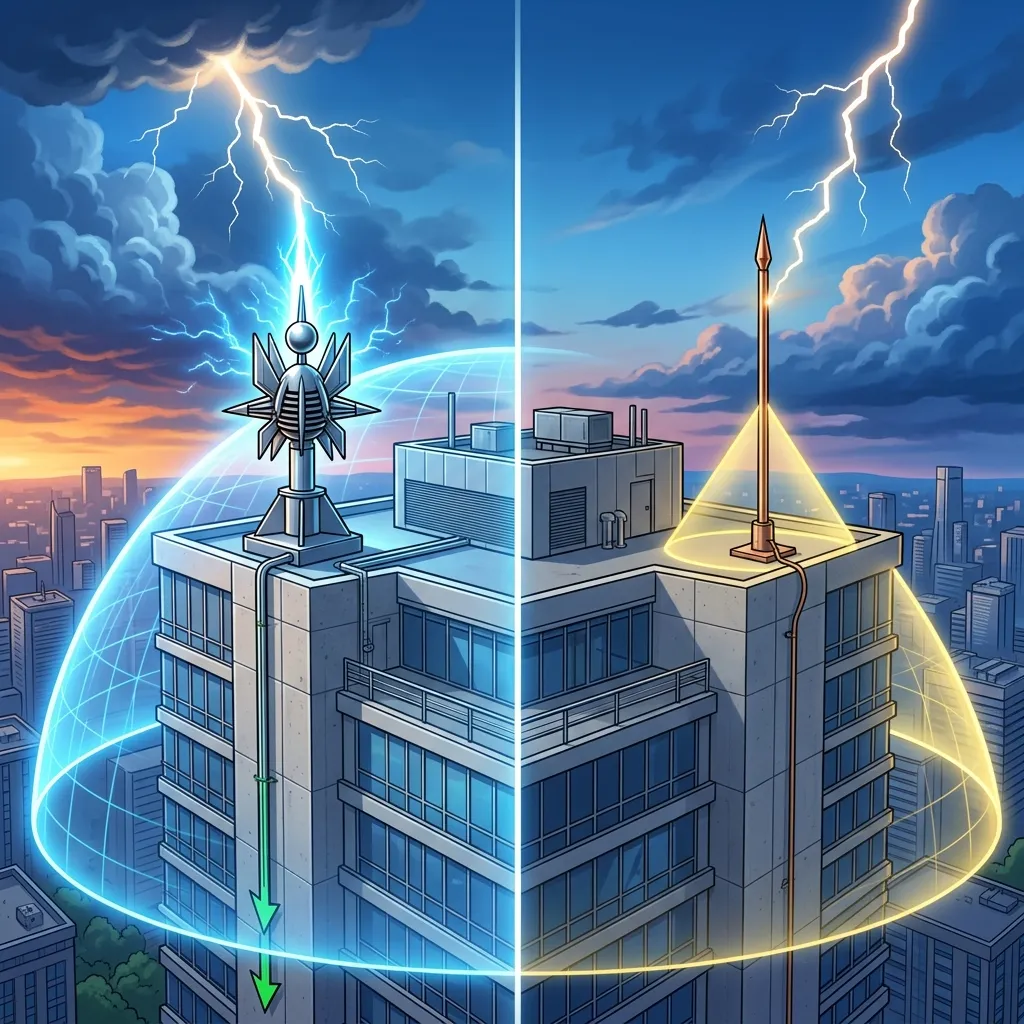
ESE Lightning Arrester vs Conventional Lightning Arrester: Key Differences Explained
There isn't much debate about the need for lightning protection. The discussion usually starts when it's time to decide which system should be installed.
Both the ESE lightning arrester and the conventional lightning arrester are widely used, and both are capable of protecting a structure when designed and installed correctly. The difference is in the protection approach, the area each system can cover, and the way the installation is planned.
Those differences become important while selecting a lightning protection system for a factory, commercial building, warehouse, or any structure where reliable protection cannot be left to assumptions.
In this blog, we'll cover the key differences: ESE lightning arrester vs conventional lightning arrester.
Key Differences Between ESE and Conventional Lightning Arresters
Once the basic working principle is understood, the comparison becomes much more practical. The differences aren't limited to the type of air terminal used. They also affect how the system is designed, the number of components required, the installation approach, and the kind of structures each system is better suited for.
Coverage Area
An ESE lightning arrester is designed to protect a larger area from a single installation point when specified according to the applicable design standard. A conventional lightning protection system usually protects a smaller zone, making multiple air terminals necessary on larger or more complex structures.
System Design
An ESE lightning protection system generally requires fewer air terminals, although every project still needs a proper risk assessment and layout. Conventional systems often involve a more distributed arrangement of air terminals to achieve complete coverage.
Installation Approach
The lightning arrester installation process differs because the layout of down conductors, air terminals, and protection zones is planned differently for each system. The complexity depends more on the structure than on the arrester itself.
Typical Applications
A building lightning protection system for a warehouse, manufacturing unit, airport, or large commercial complex may have different design priorities than a residential or low-rise structure. The selected lightning protection for buildings should always reflect the site's risk level, dimensions, and operational requirements rather than following a standard preference.
Does a Larger Protection Radius Always Make ESE the Better Choice?
A larger protection radius is often the first thing people notice while comparing lightning arresters. On paper, it can look like an obvious advantage, particularly for larger sites where reducing the number of air terminals may simplify the overall layout. Even so, that isn't enough to decide which system should be installed.
Experienced designers rarely rely on a single specification. They also consider the shape of the structure, roof details, nearby installations, and the level of lightning risk before finalising the design. In many cases, those site-specific factors have a greater influence on the final selection than the advertised coverage radius itself.
Where Is Each System Commonly Used?
There's no fixed rule that an ESE system should always be chosen over a conventional one, or the other way around. Both continue to be specified because the project itself usually decides what makes sense.
Conventional lightning arresters are still found on many residential, educational, and commercial buildings where the roof layout is relatively simple and the protection design is straightforward. An ESE system is more often seen on projects with larger footprints, where reducing the number of air terminals can simplify the overall arrangement. That is one reason it is frequently considered for industrial lightning protection, although the final selection still depends on the design study for the site rather than the type of building alone.
Which Is the Best Lightning Arrester?
There's no single answer because no two projects are exactly alike. A lightning protection design prepared for a manufacturing plant won't necessarily suit a residential tower, just as a solution developed for a heritage structure may not be appropriate for a logistics facility. Calling one option the best lightning arrester without considering the site can lead to the wrong decision.
Before recommending one system, most designers spend more time understanding the structure than looking at the product catalogue. Questions about the building usually come first:
- How tall is the structure, and what does the roof look like?
- Is it a compact building or does it spread across a large area?
- Are there taller structures nearby that could influence the protection layout?
- What level of lightning risk has been identified for the site?
- Are there project specifications or compliance requirements that need to be followed?
Only after these questions are answered does it become easier to decide which system is more appropriate. The recommendation comes from the site's requirements, not from choosing whichever product appears more advanced.
Final Thoughts
Neither system is meant to replace the other. Both continue to be specified because different buildings present different challenges. The right design is the one that suits the site, follows the applicable standards, and works alongside a suitable surge protection system. Together with dependable lightning protection products, it forms part of a practical approach to lightning safety solutions.
Every site has its own design considerations. Share your project requirements with Vasundhara Earthing, and our team will help you evaluate the options and recommend a lightning protection system that fits your application.